Zaid Hassan
Coming to Wellington and Auckland soon... sign up here to receive updates!
This is a one-day, cohort-based, hands-on workshop introducing participants to effective strategy in conditions of complexity. The workshop treats strategy as a set of practices rather than as abstract planning and focuses as much on how strategy fails (“anti-strategy”) as on how it succeeds. Participants work in teams on predefined real-world challenges and are guided through a structured sequence of practical exercises.
The workshop is explicitly introductory: participants gain applied exposure and shared understanding of multiple strategic practices, without any expectation of mastery in a single day.
— People working on complex social, institutional, or systemic challenges
— Practitioners operating in environments characterised by uncertainty, multiple actors, and unclear causal relationships
— Participants willing to work collaboratively in cohort-based teams on shared challenges
* Maximum of 30 participants.

Best Deal: 3 Event Bundle: Attend all three events (listed separately below), bundle includes book pack (hardback book, notebook, t-shirt, stickers)
— Book the 3-event bundle now and join the Talk and Author Dinner at no additional cost.
* Maximum of 30 participants.
1: Strategy & Anti-Strategy Workshop (9:30am - 5:30pm, date TBC): A one day workshop with Zaid where he introdcues the cutting-edge practice of systemic-action
Venue: The Sustainability Trust, 2 Forresters Lane, Wellington.
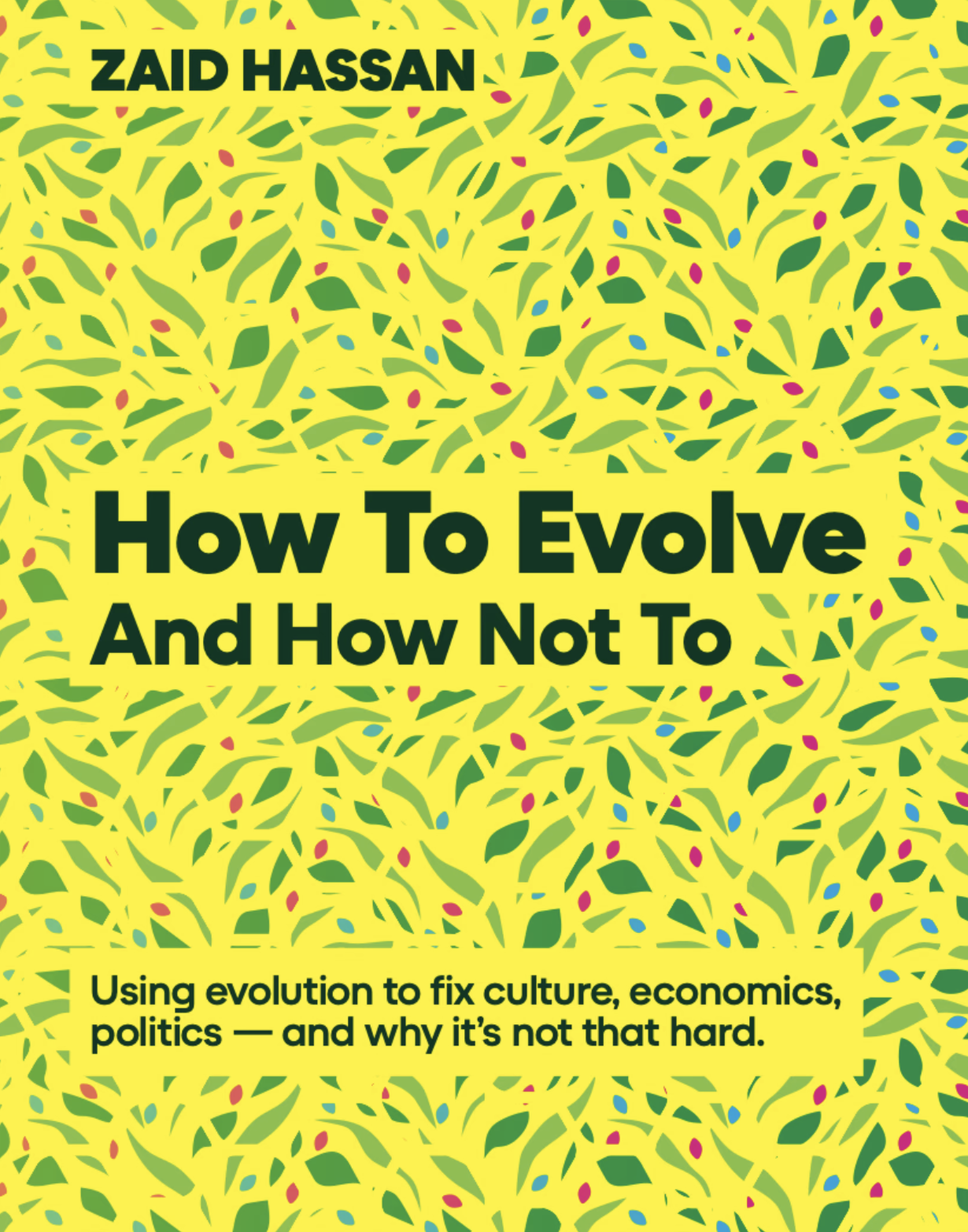
2: How to Evolve Public Lecture (6:30 - 8:00pm, date TBC): Attend an in-depth public talk and Q&A with Zaid Hassan on the core ideas from his new book.
3: How to Evolve Dinner (8:30pm, date TBC): Zaid will share behind the scenes stories with a small intimate group over a fabulous dinner (Venue: TBC)
— People working on complex social, institutional, or systemic challenges
— Practitioners operating in environments characterised by uncertainty, multiple actors, and unclear causal relationships
— Participants willing to work collaboratively in cohort-based teams on shared challenges
* Maximum of 30 participants.
Prerequisites
— No formal prerequisites
— Willingness to engage in hands-on, practice-based group work
— Upon registration, participants select from a predefined set of strategic challenges to work on
— Cohorts are formed in advance based on these selections.
This is an introductory workshop. Participants will be introduced to multiple practices and work with them through guided exercises; the aim is exposure and applied understanding, not mastery.
By the end of the workshop, participants will be able to:
— Recognise when a challenge is characterised by complexity rather than being technical or linear
— Distinguish between strategic responses that are fit for purpose and those that constitute malpractice
— Understand strategy as a set of practices rather than a single plan
— Work with complexity across existential, strategic, and tactical levels
— Identify the preconditions required for effective action
— Apply introductory versions of strategy-as-action, strategy-as-inner-game, and strategy-as-storytelling to a real challenge
— Articulate an initial, coherent strategic response appropriate to a complex context
Participants will receive the course slides, a reading list, a written case study of strategy and one case study of strategic failure for further reading after the course, a course certificate, and a digital badge.
Why attend this instead of watching a video or reading an article
This workshop is built around cohort-based learning. Participants work as a team on a shared challenge and learn to make sense of new strategic practices together. The learning emerges through hands-on exercises, coached practice, and collective sense-
making. These conditions — working with others on a live challenge and being guided through unfamiliar practices — cannot be replicated through passive, individual formats such as videos or articles.
Framing
— What is strategy
— Strategy as practice vs strategy as malpractice
Strategy as action
— Preconditions of action
— Elements of action
Strategy as inner game
— Preconditions of action
— Elements of action
Strategy as storytelling
— Preconditions of action
— Elements of action
Synthesis
— Integrating the practices into a coherent strategic response
Format and methodology
— Hands-on, practice-based workshop. The day is structured around a series of practical exercises rather than lectures.
— Exercise-led learning with coaching. Participants are set exercises aligned to each stage of the workshop and are coached through them in real time.
— Cohort-based work. Participants work in pre-assigned cohorts on a shared challenge selected prior to the workshop.
— Plenary inputs. Short teaching inputs introduce concepts and practices needed for each exercise, with emphasis on application rather than theory.
Zaid Hassan is a strategist, practitioner, and theorist whose work spans complexity, strategy, culture, political economy, and social systems. Over the past twenty-five years, he has taught, lectured, and led practice-first labs and studios globally, including at the University of Oxford, California College of the Arts (where he served as Visiting Professor), The New School (New York), NYU Berlin, the University of Bergen, RMIT Melbourne, the University of Strathclyde, and the Blekinge Institute of Technology (MSLS programme). He is currently guest faculty at the Kaospilots in Denmark, a role he has held for over a decade, and has previously served as a Social Innovation Fellow at Babson College and an Associate Fellow at Saïd Business School, University of Oxford.
He is the author of The Social Labs Revolution (2014), widely cited in design, innovation, and public policy scholarship, and How to Evolve and How Not To (forthcoming, 2026). His theoretical work includes the development of substrate realism and the Extended–Extended Evolutionary Synthesis (x-EES), an ontology integrating biological, cultural, political-economic, and environmental dynamics. His practice spans more than twenty countries and includes shaping complex multi-stakeholder processes, designing large-scale social innovations, and building climate infrastructure through Gigatonne. He is currently co-founder and CEO of Ten-in-Ten.
REFERENCES
https://xinx.co/howtoevolve

Zaid Hassan
Zaid Hassan
Coming to Wellington and Auckland soon... sign up here to receive updates!
This is a one-day, cohort-based, hands-on workshop introducing participants to effective strategy in conditions of complexity. The workshop treats strategy as a set of practices rather than as abstract planning and focuses as much on how strategy fails (“anti-strategy”) as on how it succeeds. Participants work in teams on predefined real-world challenges and are guided through a structured sequence of practical exercises.
The workshop is explicitly introductory: participants gain applied exposure and shared understanding of multiple strategic practices, without any expectation of mastery in a single day.
— People working on complex social, institutional, or systemic challenges
— Practitioners operating in environments characterised by uncertainty, multiple actors, and unclear causal relationships
— Participants willing to work collaboratively in cohort-based teams on shared challenges
* Maximum of 30 participants.
Best Deal: 3 Event Bundle: Attend all three events (listed separately below), bundle includes book pack (hardback book, notebook, t-shirt, stickers)
— Book the 3-event bundle now and join the Talk and Author Dinner at no additional cost.
* Maximum of 30 participants.
1: Strategy & Anti-Strategy Workshop (9:30am - 5:30pm, date TBC): A one day workshop with Zaid where he introdcues the cutting-edge practice of systemic-action
Venue: The Sustainability Trust, 2 Forresters Lane, Wellington.
2: How to Evolve Public Lecture (6:30 - 8:00pm, date TBC): Attend an in-depth public talk and Q&A with Zaid Hassan on the core ideas from his new book.
3: How to Evolve Dinner (8:30pm, date TBC): Zaid will share behind the scenes stories with a small intimate group over a fabulous dinner (Venue: TBC)
— People working on complex social, institutional, or systemic challenges
— Practitioners operating in environments characterised by uncertainty, multiple actors, and unclear causal relationships
— Participants willing to work collaboratively in cohort-based teams on shared challenges
* Maximum of 30 participants.
Prerequisites
— No formal prerequisites
— Willingness to engage in hands-on, practice-based group work
— Upon registration, participants select from a predefined set of strategic challenges to work on
— Cohorts are formed in advance based on these selections.
This is an introductory workshop. Participants will be introduced to multiple practices and work with them through guided exercises; the aim is exposure and applied understanding, not mastery.
By the end of the workshop, participants will be able to:
— Recognise when a challenge is characterised by complexity rather than being technical or linear
— Distinguish between strategic responses that are fit for purpose and those that constitute malpractice
— Understand strategy as a set of practices rather than a single plan
— Work with complexity across existential, strategic, and tactical levels
— Identify the preconditions required for effective action
— Apply introductory versions of strategy-as-action, strategy-as-inner-game, and strategy-as-storytelling to a real challenge
— Articulate an initial, coherent strategic response appropriate to a complex context
Participants will receive the course slides, a reading list, a written case study of strategy and one case study of strategic failure for further reading after the course, a course certificate, and a digital badge.
Why attend this instead of watching a video or reading an article
This workshop is built around cohort-based learning. Participants work as a team on a shared challenge and learn to make sense of new strategic practices together. The learning emerges through hands-on exercises, coached practice, and collective sense-
making. These conditions — working with others on a live challenge and being guided through unfamiliar practices — cannot be replicated through passive, individual formats such as videos or articles.
Framing
— What is strategy
— Strategy as practice vs strategy as malpractice
Strategy as action
— Preconditions of action
— Elements of action
Strategy as inner game
— Preconditions of action
— Elements of action
Strategy as storytelling
— Preconditions of action
— Elements of action
Synthesis
— Integrating the practices into a coherent strategic response
Format and methodology
— Hands-on, practice-based workshop. The day is structured around a series of practical exercises rather than lectures.
— Exercise-led learning with coaching. Participants are set exercises aligned to each stage of the workshop and are coached through them in real time.
— Cohort-based work. Participants work in pre-assigned cohorts on a shared challenge selected prior to the workshop.
— Plenary inputs. Short teaching inputs introduce concepts and practices needed for each exercise, with emphasis on application rather than theory.
Zaid Hassan is a strategist, practitioner, and theorist whose work spans complexity, strategy, culture, political economy, and social systems. Over the past twenty-five years, he has taught, lectured, and led practice-first labs and studios globally, including at the University of Oxford, California College of the Arts (where he served as Visiting Professor), The New School (New York), NYU Berlin, the University of Bergen, RMIT Melbourne, the University of Strathclyde, and the Blekinge Institute of Technology (MSLS programme). He is currently guest faculty at the Kaospilots in Denmark, a role he has held for over a decade, and has previously served as a Social Innovation Fellow at Babson College and an Associate Fellow at Saïd Business School, University of Oxford.
He is the author of The Social Labs Revolution (2014), widely cited in design, innovation, and public policy scholarship, and How to Evolve and How Not To (forthcoming, 2026). His theoretical work includes the development of substrate realism and the Extended–Extended Evolutionary Synthesis (x-EES), an ontology integrating biological, cultural, political-economic, and environmental dynamics. His practice spans more than twenty countries and includes shaping complex multi-stakeholder processes, designing large-scale social innovations, and building climate infrastructure through Gigatonne. He is currently co-founder and CEO of Ten-in-Ten.
Zaid Hassan
Coming to Wellington and Auckland soon... sign up here to receive updates!
This is a one-day, cohort-based, hands-on workshop introducing participants to effective strategy in conditions of complexity. The workshop treats strategy as a set of practices rather than as abstract planning and focuses as much on how strategy fails (“anti-strategy”) as on how it succeeds. Participants work in teams on predefined real-world challenges and are guided through a structured sequence of practical exercises.
The workshop is explicitly introductory: participants gain applied exposure and shared understanding of multiple strategic practices, without any expectation of mastery in a single day.
— People working on complex social, institutional, or systemic challenges
— Practitioners operating in environments characterised by uncertainty, multiple actors, and unclear causal relationships
— Participants willing to work collaboratively in cohort-based teams on shared challenges
* Maximum of 30 participants.
Best Deal: 3 Event Bundle: Attend all three events (listed separately below), bundle includes book pack (hardback book, notebook, t-shirt, stickers)
— Book the 3-event bundle now and join the Talk and Author Dinner at no additional cost.
* Maximum of 30 participants.
1: Strategy & Anti-Strategy Workshop (9:30am - 5:30pm, date TBC): A one day workshop with Zaid where he introdcues the cutting-edge practice of systemic-action
Venue: The Sustainability Trust, 2 Forresters Lane, Wellington.
2: How to Evolve Public Lecture (6:30 - 8:00pm, date TBC): Attend an in-depth public talk and Q&A with Zaid Hassan on the core ideas from his new book.
3: How to Evolve Dinner (8:30pm, date TBC): Zaid will share behind the scenes stories with a small intimate group over a fabulous dinner (Venue: TBC)
— People working on complex social, institutional, or systemic challenges
— Practitioners operating in environments characterised by uncertainty, multiple actors, and unclear causal relationships
— Participants willing to work collaboratively in cohort-based teams on shared challenges
* Maximum of 30 participants.
Prerequisites
— No formal prerequisites
— Willingness to engage in hands-on, practice-based group work
— Upon registration, participants select from a predefined set of strategic challenges to work on
— Cohorts are formed in advance based on these selections.
This is an introductory workshop. Participants will be introduced to multiple practices and work with them through guided exercises; the aim is exposure and applied understanding, not mastery.
By the end of the workshop, participants will be able to:
— Recognise when a challenge is characterised by complexity rather than being technical or linear
— Distinguish between strategic responses that are fit for purpose and those that constitute malpractice
— Understand strategy as a set of practices rather than a single plan
— Work with complexity across existential, strategic, and tactical levels
— Identify the preconditions required for effective action
— Apply introductory versions of strategy-as-action, strategy-as-inner-game, and strategy-as-storytelling to a real challenge
— Articulate an initial, coherent strategic response appropriate to a complex context
Participants will receive the course slides, a reading list, a written case study of strategy and one case study of strategic failure for further reading after the course, a course certificate, and a digital badge.
Why attend this instead of watching a video or reading an article
This workshop is built around cohort-based learning. Participants work as a team on a shared challenge and learn to make sense of new strategic practices together. The learning emerges through hands-on exercises, coached practice, and collective sense-
making. These conditions — working with others on a live challenge and being guided through unfamiliar practices — cannot be replicated through passive, individual formats such as videos or articles.
Framing
— What is strategy
— Strategy as practice vs strategy as malpractice
Strategy as action
— Preconditions of action
— Elements of action
Strategy as inner game
— Preconditions of action
— Elements of action
Strategy as storytelling
— Preconditions of action
— Elements of action
Synthesis
— Integrating the practices into a coherent strategic response
Format and methodology
— Hands-on, practice-based workshop. The day is structured around a series of practical exercises rather than lectures.
— Exercise-led learning with coaching. Participants are set exercises aligned to each stage of the workshop and are coached through them in real time.
— Cohort-based work. Participants work in pre-assigned cohorts on a shared challenge selected prior to the workshop.
— Plenary inputs. Short teaching inputs introduce concepts and practices needed for each exercise, with emphasis on application rather than theory.
Zaid Hassan is a strategist, practitioner, and theorist whose work spans complexity, strategy, culture, political economy, and social systems. Over the past twenty-five years, he has taught, lectured, and led practice-first labs and studios globally, including at the University of Oxford, California College of the Arts (where he served as Visiting Professor), The New School (New York), NYU Berlin, the University of Bergen, RMIT Melbourne, the University of Strathclyde, and the Blekinge Institute of Technology (MSLS programme). He is currently guest faculty at the Kaospilots in Denmark, a role he has held for over a decade, and has previously served as a Social Innovation Fellow at Babson College and an Associate Fellow at Saïd Business School, University of Oxford.
He is the author of The Social Labs Revolution (2014), widely cited in design, innovation, and public policy scholarship, and How to Evolve and How Not To (forthcoming, 2026). His theoretical work includes the development of substrate realism and the Extended–Extended Evolutionary Synthesis (x-EES), an ontology integrating biological, cultural, political-economic, and environmental dynamics. His practice spans more than twenty countries and includes shaping complex multi-stakeholder processes, designing large-scale social innovations, and building climate infrastructure through Gigatonne. He is currently co-founder and CEO of Ten-in-Ten.
Zaid Hassan









.jpg)


.jpg)